


It is one of the most frustrating questions a homeowner can face.
You listed the home. You prepared for showings. You waited.
And nothing happened.
Or maybe you got a little activity in the beginning and then it went quiet. The days on market keep climbing, and you are starting to wonder what went wrong.
Here is the honest answer: most homes that sit unsold have at least one fixable problem. Sometimes two or three. The good news is that once you identify them, you can address them. The hard part is being willing to look at your home the way a buyer does, not the way you do.
I have helped sellers across Charlotte, NC and the greater Carolinas navigate stalled listings, and the reasons homes do not sell tend to follow a recognizable pattern. Let me walk you through the most common ones.
The Most Common Reasons a House Is Not Selling
1. The Price Is the Problem
I will say it plainly because most people already know it and are hoping it is something else.
Overpricing is the single most common reason a home sits.
Buyers today are informed. They are tracking the market, comparing active listings, and making decisions quickly. When a home is priced above what the market supports, buyers do not make lowball offers. They simply move on to the next listing.
And here is what makes overpricing so damaging: the longer a home sits, the more buyers wonder what is wrong with it. A listing that has been on the market for 60 days carries a stigma that a freshly listed home does not. By the time a price reduction happens, the most motivated buyers have already purchased something else.
The “list high and lower it later” strategy sounds logical.
In practice, it almost always costs sellers more than they would have netted with an accurate price from the start.
Do you have more questions about pricing? Read: How Much Can I Sell My House For
2. The Condition Does Not Match the Price
A buyer’s willingness to pay top dollar is directly tied to what they see when they walk in the door.
Deferred maintenance, dated finishes, odors, clutter, personal items covering every surface: these things do not just affect how a home looks. They affect how a buyer feels about the price. If a home shows signs of wear or needs work, buyers factor the cost of those repairs into what they are willing to offer, and they are rarely generous in that math.
Move-in-ready matters.
Surveys consistently show that the vast majority of buyers are not willing to compromise on condition. If your home requires significant updates or has visible maintenance issues, the price needs to reflect that, or the issues need to be addressed before you list.
Home preparation matters. In my blog, How to Prepare for the Spring Real Estate Market, I cover some basic home prep that’s applicable beyond the spring months.
3. The First Impression Is Costing You Showings
Most buyers make a decision about a home before they ever walk through the front door.
It starts with the listing photos online. If the photography is poor, dark, or shows a cluttered, unprepared space, buyers scroll past. Professional listing photos generate significantly more online views and sell homes faster than amateur photography. This is not optional at any price point.
It continues with curb appeal. A buyer who drives past and sees an untidy exterior, overgrown landscaping, or a weathered facade has already formed an opinion before the front door opens.
First impressions are not recoverable in real estate.
If you lose a buyer before they step inside, they are not coming back.
4. Showings Are Difficult to Schedule
If buyers cannot get into your home, they will buy someone else’s.
Restrictive showing windows, short-notice requirements, or homes that require constant coordination to access all create friction. In a competitive market, a buyer’s agent scheduling four or five showings in an afternoon will skip the difficult one and move to the next.
Flexibility is not just convenient. It is a competitive advantage.
What should you expect with home showings as a seller? Read: What’s the Average Number of Showings to Sell a House?
5. The Marketing Is Not Reaching the Right Buyers
Getting a home onto the MLS is the starting point, not the finish line.
A home that is not being actively marketed through professional photography, targeted digital advertising, social media exposure, and agent-to-agent outreach is leaving a significant portion of the potential buyer pool untouched. The buyers who are most likely to pay top dollar for your home are not always the ones browsing Zillow on a Tuesday night. Reaching them requires intentional, multi-channel marketing.
If you are not sure what your agent is doing beyond entering the listing into the system, that is a conversation worth having.
Here are a few more posts that discuss the importance of marketing when it comes to selling your home:
- How to Sell Your Home Fast in Charlotte: Expert Tips to Maximize Speed and Profit
- How to Attract International Real Estate Buyers
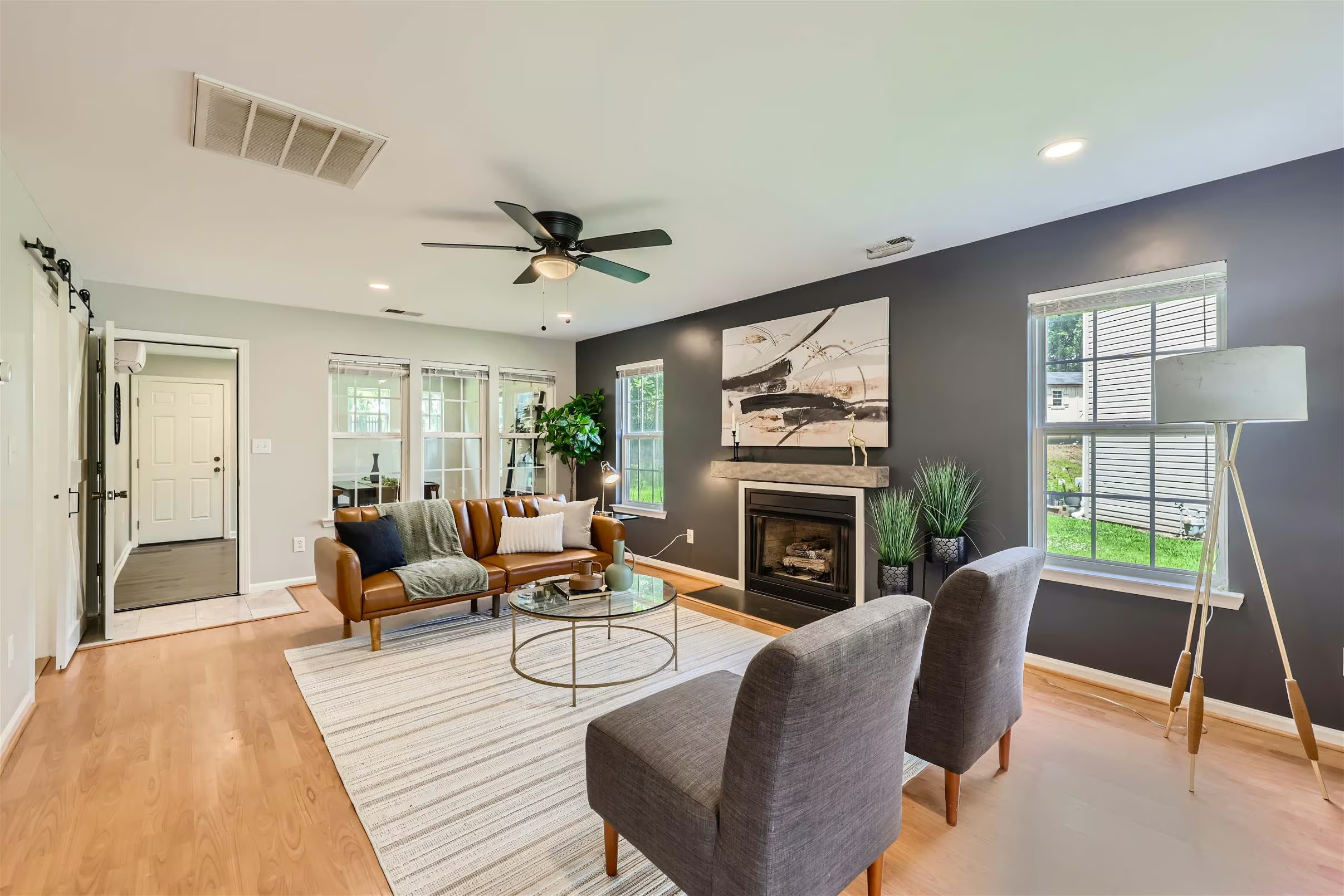
6. The Home Is Not Staged or Presented Well
Buyers buy emotion before they buy square footage.
A home that feels warm, clean, and easy to imagine living in creates a very different response than one that feels lived-in, crowded, or hard to read.
At minimum, staging means decluttering, depersonalizing, cleaning deeply, and presenting each space in a way that helps buyers see themselves there. A full professional staging goes further, and the results consistently show it.
Before you dismiss the cost of staging, consider this: staging is cheaper than your first price reduction.
It does not justify overpricing your home. It helps justify its actual value and creates a vision buyers can see themselves living in. That is a meaningful distinction.
An empty home presents its own challenges. Without furniture and context, buyers struggle to understand scale and use of space. Virtual staging or minimal furnishings can make a meaningful difference here as well.
Check out some of my Client Success Stories to see some strategies that have worked well for my sellers in the past.
7. The Market Has Shifted
Sometimes the home is priced right, presented well, and still sitting.
Markets move. What was accurate six months ago may not reflect what buyers are willing to pay today. Interest rates, inventory levels, and buyer sentiment all shift, sometimes quickly, and a listing that was competitive at launch may need to be reassessed as conditions change.
This is not a reason to panic. It is a reason to stay informed and work with someone who is actively monitoring what is happening in your specific price range and neighborhood, not just the broad market.
8. The Agent’s Strategy Is Not Working
Not all agents approach a listing the same way.
Some are highly active: monitoring showing feedback, adjusting strategy, communicating regularly, and bringing market intelligence to every conversation. Others enter the listing and wait.
If you are not receiving consistent updates, specific feedback from showings, and proactive recommendations based on what the market is telling you, it may be time to have an honest conversation about whether the current approach is serving your goals.
What about discount agents? It might seem like a good idea at the time, but often, their strategies are just not up to par. Read my post about the Dangers of Discount Realtors to learn more.
9. The Expectations Do Not Match the Reality
This one is harder to say, and harder to hear.
Sometimes a home is not selling because the seller is not willing to accept what the market is telling them.
The desire to maximize your outcome is completely understandable. Everyone wants to net as much as possible. But when the recent relevant sales do not support the price, when buyers are consistently passing, when the feedback points to the same issues over and over, and the response is to wait for a different buyer rather than reassess the strategy, the market has already given its answer.
It does not work to list high, do the bare minimum on preparation, and expect a buyer to come along and start a conversation anyway. Buyers have options. They are not going to negotiate a seller down from an aspirational price on a home that is not showing well. They are going to buy something else.
There are also sellers who are surprised to find their home is worth more than they expected. That happens, and it is a good problem to have.
But for sellers whose desired net does not align with fair market value, the choice becomes clear: adjust the price, invest in the preparation that justifies the price, or accept that the home may not sell under the current approach.
Wanting a specific outcome and being unwilling to do what it takes to get there are two things that cannot coexist in this market for long.
The sellers who get the best results are the ones who trust the process, listen to the data, and make strategic decisions even when those decisions are uncomfortable.
That is not a criticism. It is just how it works.
A great real estate agent will be forthcoming about your expectations and transparent at every step of the process. Learn more about what to look for in a great agent. Read: How to Find the Top Charlotte Real Estate Agent to Sell Your Home.
A Seller’s Checklist: Questions to Ask When Your Home Is Not Selling
Use this as a starting point for an honest reassessment. These are the same questions I work through with sellers when a listing needs a new strategy.
Pricing
- Is the price supported by recent comparable sales in my neighborhood?
- Have I accounted for the current state of the market, not where it was three or six months ago?
- Am I pricing to what I want to net, or to what buyers are actually paying?
- Has the market shifted since I listed?
Condition and Presentation
- Are there deferred maintenance items a buyer would notice immediately?
- Does the home smell clean and feel neutral to someone walking in for the first time?
- Have I removed personal items, excess furniture, and clutter?
- Do the kitchen and bathrooms feel updated and well-maintained?
- Is the exterior presenting well, including landscaping, paint, and entryway?
Photography and Marketing
- Were the listing photos taken by a professional?
- Do the photos show the home at its best, with good light and thoughtful staging?
- Is the home being actively marketed beyond the MLS?
- Am I receiving regular updates on how the listing is performing online?
Access and Showings
- Are my showing windows flexible enough to accommodate buyer schedules?
- Is the home easy for agents to access without excessive coordination?
- Am I making it as easy as possible for buyers to get inside?
Feedback and Strategy
- What is the feedback from buyers who have toured the home?
- Are there consistent themes in what they are saying?
- Is my agent bringing me data and recommendations, or just updates?
- Have we discussed a specific plan of action if the listing continues to sit?
When Should You Worry About Your House Not Selling?
The honest answer: sooner than most sellers think.
The first two weeks of a listing are the highest-traffic window. That is when the most buyers are paying attention, when the listing feels new, and when motivated buyers are most likely to act. If you are not generating meaningful activity in that window, something needs to be addressed quickly.
Waiting and hoping the right buyer will eventually come along is rarely a winning strategy. A home that sits accumulates days on market, and those days are visible to every buyer and buyer’s agent who pulls up your listing. They ask why. And the longer the answer is “it just has not sold,” the harder the position becomes.
If your home has been on the market for more than two to three weeks without serious offers, it is time to have a direct conversation about what needs to change.
And if you decide to wait two weeks and then drop the price, it is already too late.
Learn more about my services and my unique approach to selling your home. Read: Reasons to Sell Your Charlotte, NC Home with Ashley Horton
Thinking About Relisting or Need a Second Opinion?
If your home has not sold and you are trying to understand why, I would like to help.
I offer honest, data-backed seller consultations for homeowners in Charlotte, NC and across the greater Carolinas. Whether you are currently listed with another agent or simply reassessing your options, the conversation costs you nothing.
Book a Seller’s Consultation or reach out directly:
704.975.5418 | ashley.horton@charlotteluxehomes.com
Your home can sell.
Most of the time, it just needs the right strategy, the right price, and the right representation to get there.
Ashley Horton is a luxury real estate advisor with Premier Sotheby’s International Realty, serving sellers across Charlotte, NC, South Charlotte, Myers Park, SouthPark, Ballantyne, Waxhaw, Weddington, Matthews, Mint Hill, Fort Mill, Tega Cay, Indian Land, Lake Wylie, and York and Lancaster counties. She holds MRP, ABR, CLHMS, and Global Real Estate Advisor designations.

It Starts with a Conversation!
Buying, selling, or relocating to Charlotte? Get in touch with me here to get started!