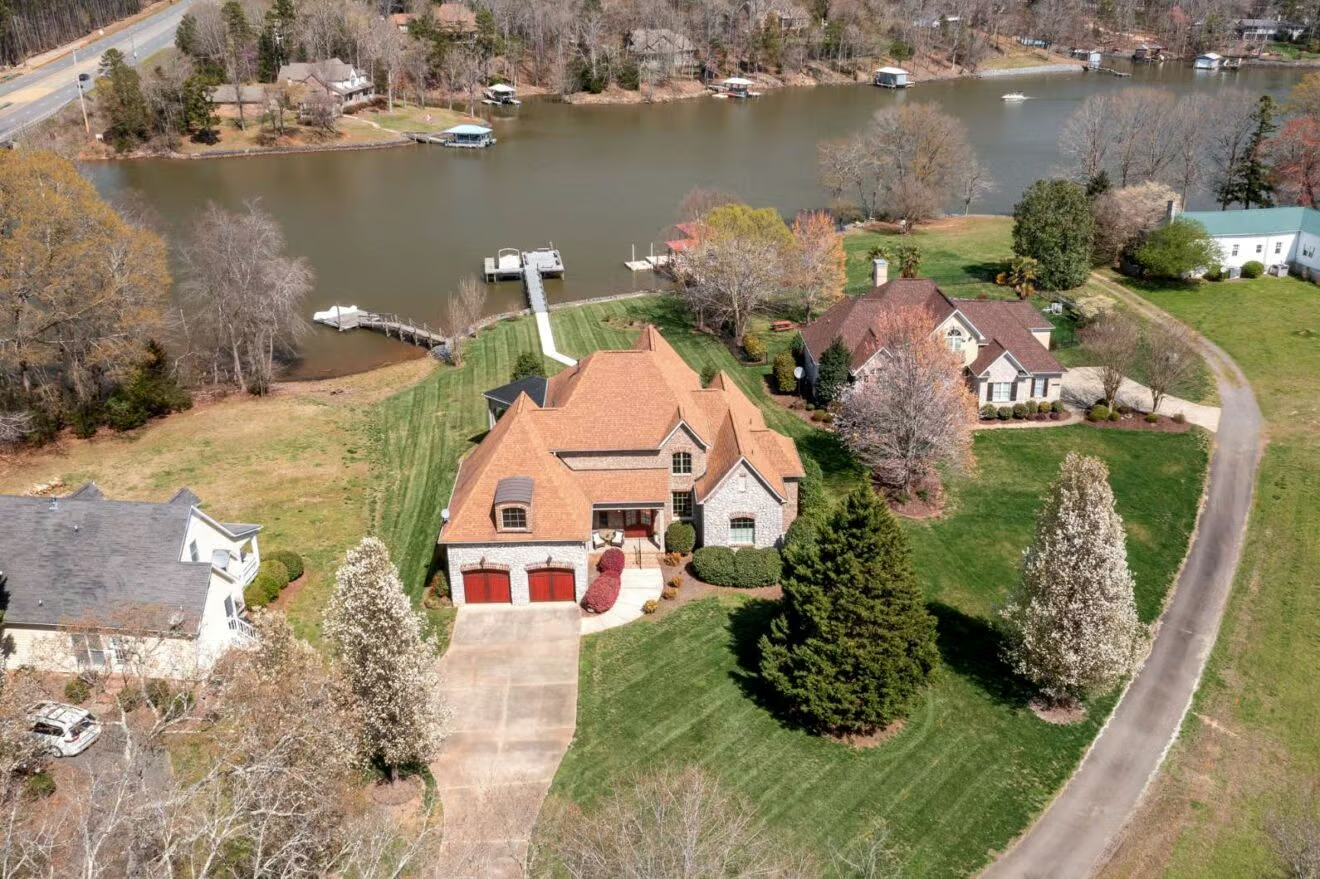
Buying a waterfront home in Charlotte sounds pretty straightforward. Find the house, make sure you love the view, confirm there’s a dock and start picturing Saturday mornings on the boat.
I wish it were that simple.
Waterfront property has another layer of due diligence that most buyers don’t encounter when purchasing a traditional home. Around Charlotte, that conversation usually centers on Lake Norman and Lake Wylie, both part of the Catawba-Wateree river system and both managed in part by Duke Energy under its federal hydroelectric license. Then you add county regulations, state requirements, HOA rules, utilities, flood considerations and whatever you specifically want to do with the property.
Suddenly, “waterfront” doesn’t tell you nearly enough.
If you’re searching Charlotte waterfront homes, especially if your goal is a private dock, boating access or eventually building on the water, there are a few things I want you to understand before you fall in love with the view.
First, Waterfront, Water View and Lake Access Are Not the Same Thing
This sounds obvious until you start looking at listings.
A waterfront home generally means the property actually adjoins the water. A water-view property may have a beautiful view without touching the shoreline at all. Lake access could mean anything from a community boat ramp to walking trails along the water, and a home advertised with a boat slip may have access to a marina slip that is deeded, assigned, licensed or leased separately from the house.
Then there’s “dockable.”
That word gets my attention because if having your own dock is important to you, I don’t want to rely on an assumption that one can be built simply because the property has shoreline. Before treating a waterfront lot as dockable, we need to verify it.
How much shoreline does the property have? What is the shoreline classification? How wide is the cove? How deep is the water? Are there environmental restrictions? What do Duke Energy, the county and potentially the HOA allow?
And if you’re wondering where you actually find those answers, I would start with Duke Energy Lake Services and the Catawba-Wateree Shoreline Management Plan. Duke manages private docks, piers and other shoreline uses within the hydroelectric project boundary on both Lake Norman and Lake Wylie. Their Shoreline Management Plan also includes shoreline classification maps, which identify how different portions of the shoreline are designated and what types of uses may be considered there.
Why does something like shoreline length matter? Because a dock has to fit within the usable area associated with your property while also meeting Duke’s requirements for placement, neighboring property lines, navigation and the physical characteristics of that portion of the lake. A wide waterfront lot on open water can present a very different permitting scenario than a narrow lot tucked into a small cove.
Shoreline classifications matter for a similar reason. Duke’s Shoreline Management Plan classifies shoreline for different types of uses and protection, including areas intended for residential access and areas where environmental, cultural, public recreation or other considerations may limit development. I don’t expect a buyer to become an expert in those classifications. I do want to know what classification applies to the property before we treat a future dock as part of its value.
For a specific property, this isn’t something I would try to answer from the MLS or the listing agent’s assurance that “the neighbors have docks.” We can review Duke’s mapping and existing permits first, then contact Duke Energy Lake Services about the specific parcel and what you’re hoping to build. If you’re seriously considering purchasing the property, a current survey showing the shoreline, property boundaries and Duke project boundary becomes incredibly valuable.
The answer for the property next door isn’t necessarily the answer for yours.
Looking for a waterfront home? Here are the neighborhoods where you can find waterfront properties in Charlotte, NC.
Who Actually Controls the Shoreline?
This is probably the part that surprises buyers the most.
Lake Norman and Lake Wylie are not simply natural lakes surrounded by privately owned shoreline. They’re part of Duke Energy’s Catawba-Wateree hydroelectric system, which means Duke Energy Lake Services has authority over docks, piers, shoreline stabilization, dredging and other activities within the hydroelectric project boundary.
So, yes, you can own waterfront property and still need someone else’s permission to change what happens at the water.
The county matters too. Lake Norman touches multiple North Carolina counties, while Lake Wylie crosses North Carolina and South Carolina. A Lake Wylie property in Mecklenburg County and one directly across the water in York County may look like they’re governed by the same lake rules, but state and local requirements can be different.
That’s why I don’t approach waterfront due diligence with a generic Lake Norman or Lake Wylie checklist and call it done. We have to look at the actual property and the jurisdiction it’s sitting in.
If you want to see where that hydroelectric project boundary actually falls, Duke’s Catawba-Wateree Shoreline Management Plan and shoreline classification maps are the starting point. On the North Carolina portions of these lakes, there’s also a surprisingly useful definition in the state’s Catawba River buffer rule: the landward edge of the lake at Duke Energy’s full pond level represents the project boundary.
That’s another reason a survey matters on a waterfront purchase. Where the lawn appears to end and where the legally relevant boundary sits are not necessarily something I want to determine by standing in the backyard and looking at the water.
Real estate strategy in Charlotte varies greatly depending on the property type you’re looking for. Here are a few more posts you may find interesting:
- Where to Find the Best Country Club Communities in Charlotte, NC
- Best Gated Communities in Charlotte, NC
- What to Know About Living in Riverchase Estates
What About Riparian Rights?
You’ll hear the term “riparian rights” when researching waterfront property. In very simple terms, riparian rights refer to certain rights associated with land adjoining water.
What they do not mean is that you can automatically build whatever you want at the shoreline.
That distinction is particularly important here because Lake Norman and Lake Wylie are federally licensed hydroelectric reservoirs. Your property rights, Duke Energy’s project boundary and permitting authority, environmental regulations and local zoning can all overlap.
So if your plan is, “I’ll buy the lot and add a dock later,” that’s something I want investigated before you purchase the property, not after.
About That 50 Foot Rule
This is another one that gets repeated in ways that make it sound much simpler than it is.
There are 50 foot shoreline protections in our area, but there isn’t one universal “Duke Energy owns the first 50 feet and you can’t touch it” rule.
On the North Carolina side, the Catawba River Basin riparian buffer rules protect a 50 foot vegetated area along the main stem of the Catawba and its main-stem lakes, including Lake Norman. The first 30 feet is generally the more restrictive portion of that buffer, with the remaining 20 feet treated differently.
On the South Carolina side of Lake Wylie, York County has its own 50 foot natural shoreline buffer measured from the full pond elevation contour.
Then there can be local building setbacks, easements, HOA restrictions and Duke Energy requirements layered on top. This is why I want the survey, permits and governing documents in front of us. “It’s 50 feet” isn’t enough information to make a buying decision.
Sources to verify the shoreline-buffer rules:
- NC Department of Environmental Quality, Catawba River Buffer Rules
- NC DEQ Riparian Buffer Protection Program and Mapping Tools
- NC DEQ, Understanding Catawba Buffer Rules
- York County Lake Wylie/Catawba River Planning Documentation
If There’s Already a Dock, Don’t Assume You’re Done
An existing dock is not something I simply check off as “present.” I want the paperwork.
Duke Energy recommends that prospective buyers ask the seller for the pier permit and application so the existing structure can be compared with what was actually approved. This matters because Duke will only release its permitting records when those records are in the seller’s name.
And yes, sometimes a homeowner discovers that a dock permit was never properly updated after a previous sale.
That’s something I’d much rather find out during due diligence than after closing.
I also want to know whether what exists today matches what was permitted. Was a boat lift added later? Was the dock expanded? Was a roof added? Has shoreline stabilization been modified?
The fact that a structure has physically been there for years does not automatically mean everything about it is compliant.
What If You Want to Build a Dock?
This is where “waterfront” and “usable waterfront” can become two very different things.
A property can have beautiful shoreline and still not support the dock you have pictured in your head.
Duke Energy Lake Services reviews shoreline activities under its Shoreline Management Plan, and local permitting can also be required. In Iredell County, for example, the county specifically requires Duke Energy shoreline compliance for Lake Norman pier facilities, and county building permits are part of the process.
Before buying with plans for a new dock, I’d want to investigate what is actually feasible for that parcel. Dock size, distance into the water, projected property lines, cove width, water depth, shoreline classification and environmental conditions can all matter.
Floating versus fixed construction can matter too, particularly when you’re dealing with fluctuating lake levels.
This is also where new construction waterfront homes in North Carolina require a little more scrutiny than buyers sometimes expect. A gorgeous new home on the water doesn’t automatically mean every shoreline improvement you envision has already been approved.
The house and the shoreline are two separate due diligence conversations.
More Resources:
- York County/Lake Wylie/Catawba River Buffer Permit Application
- Lake Wylie Marina Commission, Who to Call
- Duke Energy Catawba-Wateree Shoreline Management Plan
Usable Waterfront Is More Important Than the Number of Feet
“200 feet of waterfront” sounds impressive.
But what does that 200 feet actually give you?
I care about the quality of the water access just as much as the quantity of shoreline. Is it deep enough for the type of boat you own? What happens when lake levels fluctuate? Is it tucked into a quiet cove or exposed to heavy boat traffic and wake? Can you navigate from the property to the main channel easily? Are there bridges between the house and where you want to boat, and does your boat clear them?
Even the orientation of the property matters. One buyer may want expansive main-channel views and activity. Another wants protected water where the kids can paddleboard without constant boat traffic.
Neither is better. They’re different versions of lake living.
The important part is making sure you’re buying the version you actually want.
A Private Dock and a Boat Slip Are Two Different Conversations
Not every buyer needs private waterfront.
For some, a home with a deeded or assigned boat slip in a community marina is perfect. They get boating access without maintaining a private dock and shoreline.
But I still want to know exactly what comes with the property.
Is the slip deeded? Is it a limited common element? Is it assigned by the HOA? Is it leased from a marina? Can it transfer when the home sells? Are there separate dues? Size restrictions? A waiting list?
A leased marina slip should not be treated like a privately permitted dock attached to waterfront property, and neither should be assumed to convey simply because the listing says “boat slip.”
The paperwork answers that question.
City Sewer Doesn’t Always Mean Gravity Sewer
This is one of those details most people don’t associate with buying a lake house until they encounter one.
Some waterfront properties around Charlotte use low-pressure sewer systems because the topography makes traditional gravity sewer impractical. That can mean a grinder pump or another private pump system is part of the property.
If you’ve never heard of a grinder pump, the easiest way to think about it is as a small wastewater pump for your home. Wastewater from the house flows into a holding tank, the pump breaks down the solids and then pushes the wastewater through a pressurized sewer line until it reaches the public sewer system.
Why would a waterfront home need one? Gravity normally does the work in a traditional sewer system, but lakefront topography doesn’t always cooperate. If the house sits lower than the public sewer line or the terrain doesn’t allow wastewater to flow downhill naturally, a pump can do the work gravity can’t.
So “city water and sewer” doesn’t necessarily mean there’s nothing mechanical on the property to maintain. That’s why I want to know whether a grinder pump exists, who owns and maintains it, how old it is and what happens if it fails.
That’s not automatically a problem. It is something you need to understand.
Who maintains the pump? Who pays when it fails? Is there an alarm? How old is it? Is there an easement for access? Does the utility maintain any portion of the system or is it entirely the homeowner’s responsibility?
Those are much better questions to ask before closing than the first time an alarm starts going off.
And if the property is on septic instead, that’s another due diligence path entirely, especially when future additions, pools or renovations are part of your plan.
Lake Wylie Has an Extra Layer Because It Crosses State Lines
Lake Wylie is particularly interesting because you can cross the lake and cross state lines at the same time.
Duke Energy’s shoreline management authority applies across the Catawba-Wateree system, but the land around the water is still subject to the laws and local regulations of whichever state and county the property sits in.
York County, South Carolina has its own Lake Wylie shoreline buffer requirements. Mecklenburg and Gaston counties sit on the North Carolina side. Boating rules can also differ between North Carolina and South Carolina, even though you’re enjoying the same body of water.
That doesn’t make buying on Lake Wylie difficult. It just means “my friend owns across the lake and was allowed to do it” isn’t enough due diligence.
Don’t Forget the Less Exciting Stuff
The dock and view are fun. I still want to know about everything else.
- Flood zones and insurance
- Seawalls and shoreline stabilization
- Erosion
- Dock electrical systems
- Septic or sewer
- Water depth
- HOA restrictions
- Boat storage
- Maintenance costs
- Trees near the shoreline
- What you’re allowed to clear or landscape
- Whether the dock and shoreline structures are properly permitted
And if you’re buying because you have a specific vision for the property, whether that vision is actually possible.
Waterfront homes can command a premium because the lifestyle is hard to replicate. That also means mistakes during due diligence can be expensive.
Final Thoughts
Buying a waterfront property in Charlotte isn’t just about finding the prettiest view.
It’s understanding exactly what you’re buying with it.
The shoreline matters. The water matters. The dock matters. The paperwork matters. The jurisdiction matters. And sometimes the thing you assumed you could change after closing is the one thing you can’t.
That’s why I approach Charlotte waterfront homes differently from a traditional home search. I want to understand how you plan to use the property first, then help you investigate whether the home, the shoreline and the rules surrounding it actually support that lifestyle.
Because there’s a big difference between buying a home that happens to be on the water and buying the waterfront life you pictured when you started looking.
Ashley Horton | 704.975.5418 | ashley.horton@charlotteluxehomes.com
Global Real Estate Advisor
Licensed in North Carolina & South Carolina
Premier Sotheby’s International Realty


It Starts with a Conversation!
Buying, selling, or relocating to Charlotte? Get in touch with me here to get started!